The Laboratory of God
The Body’s Rivers
Meridians, qi, and the traditional Chinese organ clock—an illustrated introduction to a body map developed outside modern anatomy.
By Olga S., Founder & Practitioner · August 5, 2026 · 4 min read
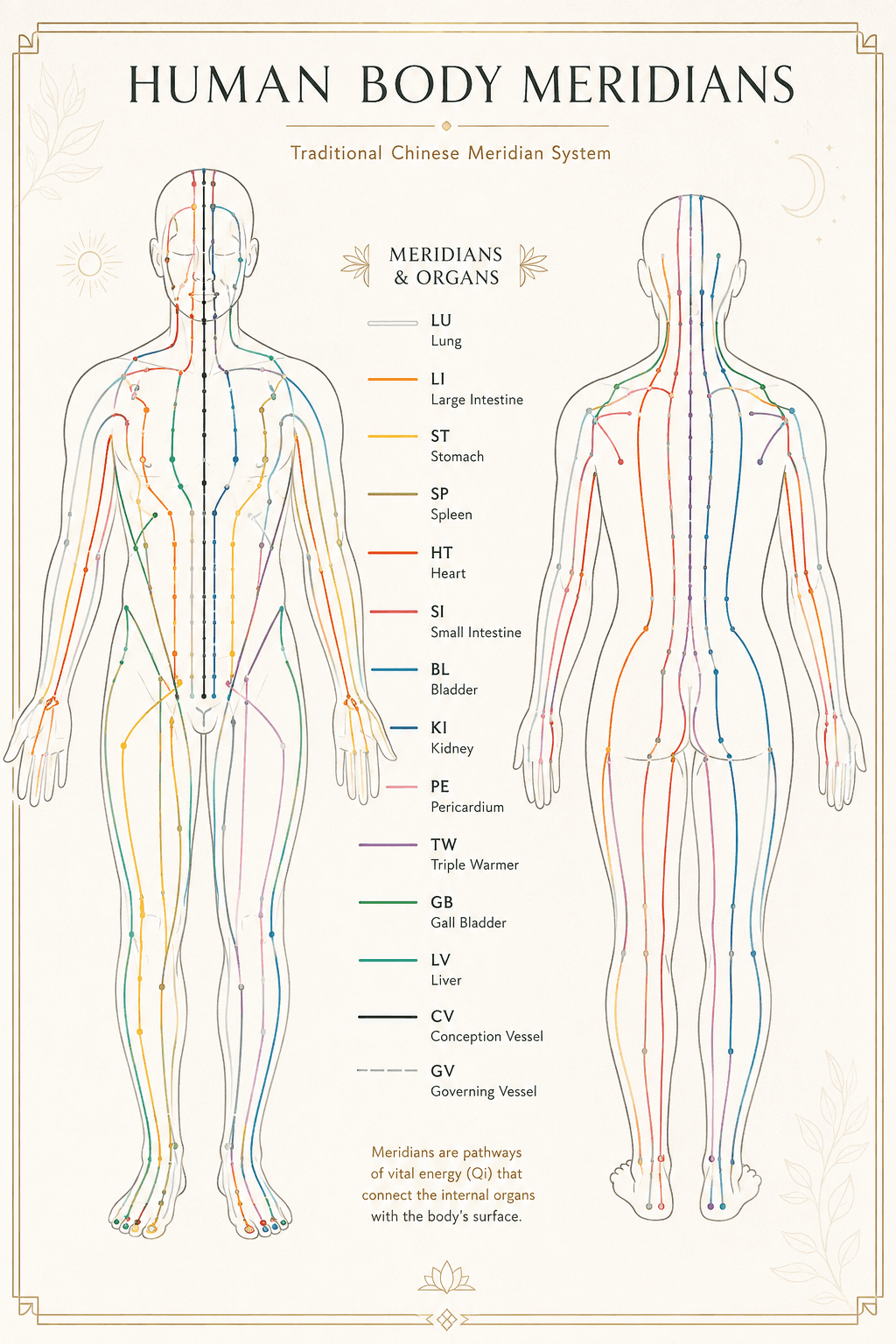
A traditional map of movement
Long before modern anatomy could visualize nerves or trace lymphatic vessels, practitioners in China developed another way of describing movement through the body: a current they called qi. They followed its patterns, named its pathways, and passed the map from one generation to the next.
Meridian theory became one of the organizing frameworks of traditional Chinese medicine. It is a language for relationship and function—not a replacement for the nerves, vessels, fascia, organs, or other structures recognized by contemporary anatomy.
Twelve primary channels
Traditional teaching describes twelve primary channels associated with functional organ systems: lung, large intestine, stomach, spleen, heart, small intestine, bladder, kidney, pericardium, triple warmer, gallbladder, and liver. The map also commonly includes the conception and governing vessels shown in the illustration.
A meridian is not the organ itself. Within this traditional model, it is closer to the organ system’s reach—the pathway through which its influence is understood to travel toward the skin, limbs, head, and face. Even the organ names carry broader functional meanings in Chinese medicine than their anatomical namesakes do in biomedicine.
Each channel has its hour
The traditional Chinese organ clock gives each primary channel a two-hour period. The lung channel is assigned 3 to 5 in the morning; the liver channel, 1 to 3. In this view, the body is not uniform through the day. It is a rotation, with each system understood to take its turn.
These hours belong to a historical interpretive framework. They should not be used alone to explain waking, pain, illness, or a change in symptoms.
Clear, held, and obstructed
Traditional teaching describes well-being as the free movement of qi and describes obstruction through the language of tension, cold, repeated posture, and held emotion. A practitioner may interpret a sensation somewhere along a channel rather than only at the organ whose name it carries.
This is the traditional reasoning behind considering a shoulder in relation to a longer pathway, or working with a point on the foot while attending to the abdomen. These relationships are part of the meridian model; they are not proof of an anatomical connection or a diagnosis of organ disease.
Where bodywork meets the map
Every stroke crosses these mapped lines whether we name them or not. For RA SPHERA, the value of the map is attentiveness: noticing direction, continuity, temperature, resistance, breath, and the relationships between one part of the body and the whole.
The map can deepen a conversation with the body without asking it to replace anatomy, evidence, medical evaluation, or the client’s own experience.
Meridians and qi are traditional Chinese medicine concepts. Physical meridian structures have not been established as nerves, blood vessels, or lymphatic vessels. RA SPHERA does not use this map to diagnose medical diseases or disorders.