The Laboratory of God
The Eye Practice
Five points around the orbital rim, a circular massage, slow eye movements, and a final minute of darkness and warmth.
By Olga S., Founder & Practitioner · August 5, 2026 · 5 min read
A few quiet minutes for heavily used eyes
The eyes are asked to focus, shift, track, and absorb light throughout the day, often with very little variation in distance. This traditional sequence brings together light acupressure around the bony eye socket, a circular facial massage, deliberate eye movement, and palming.
Although it is often introduced as a one-minute practice, the full sequence described here takes several minutes when the points are held slowly and repeated. There is no benefit in rushing it.
Before you begin
Wash and dry your hands and remove contact lenses. Sit somewhere stable. Keep all pressure on the bone around the eye socket—never on the eyelid or eyeball. A tiny amount of a product specifically tolerated around your eyes may be used for the circling portion, but keep it away from the lash line and stop if it stings or blurs the vision.
Skip periocular massage after an eye or orbital injury, recent procedure or surgery, or during active redness, swelling, infection, or inflammation. If you have glaucoma, retinal disease, significant eye disease, or instructions to avoid pressure around the eyes, ask your eye-care clinician before trying it.
The five points
All five points sit on the bony rim of the eye socket or at the temples—not on the soft eye. Use the broad pad of a finger, begin with barely perceptible pressure, hold for one slow count of ten, and release. Repeat up to three rounds only if it remains comfortable.
Tenderness is a reason to lighten the touch or stop. Some traditions interpret a tender point as congestion, but tenderness is nonspecific and does not identify an eye condition or blocked energy pathway.
- 1Inner corner, upper rim. Place the finger pads in the small bony hollow at the upper inside corner of each orbit. Keep clear of the eyeball and bridge-side soft tissue.
- 2Under the center of the eye. Find the middle of the lower bony rim and press gently toward the bone—not upward into the eye and not down into the cheek.
- 3Under the outer eye. Move along the lower bony rim to a point roughly one-quarter of the way in from the outer corner.
- 4Above the outer eye. Find the upper bony rim roughly one-third of the way in from the outer corner and use very light pressure.
- 5Temples. Follow the eyebrow outward to the soft hollow at the side of the head. Use a gentle hold or a very small circle.
The circle
Place three relaxed fingertips near the inner ends of the eyebrows. Travel up beside the bridge of the nose, outward along the brows toward the temples, then down and back along the lower orbital rims toward the nose. Make small, unhurried circles without stretching the eyelid skin.
The inherited instruction keeps the movement in this direction. Ten light passes may form one round; pause before repeating, for no more than three comfortable rounds.
The movement
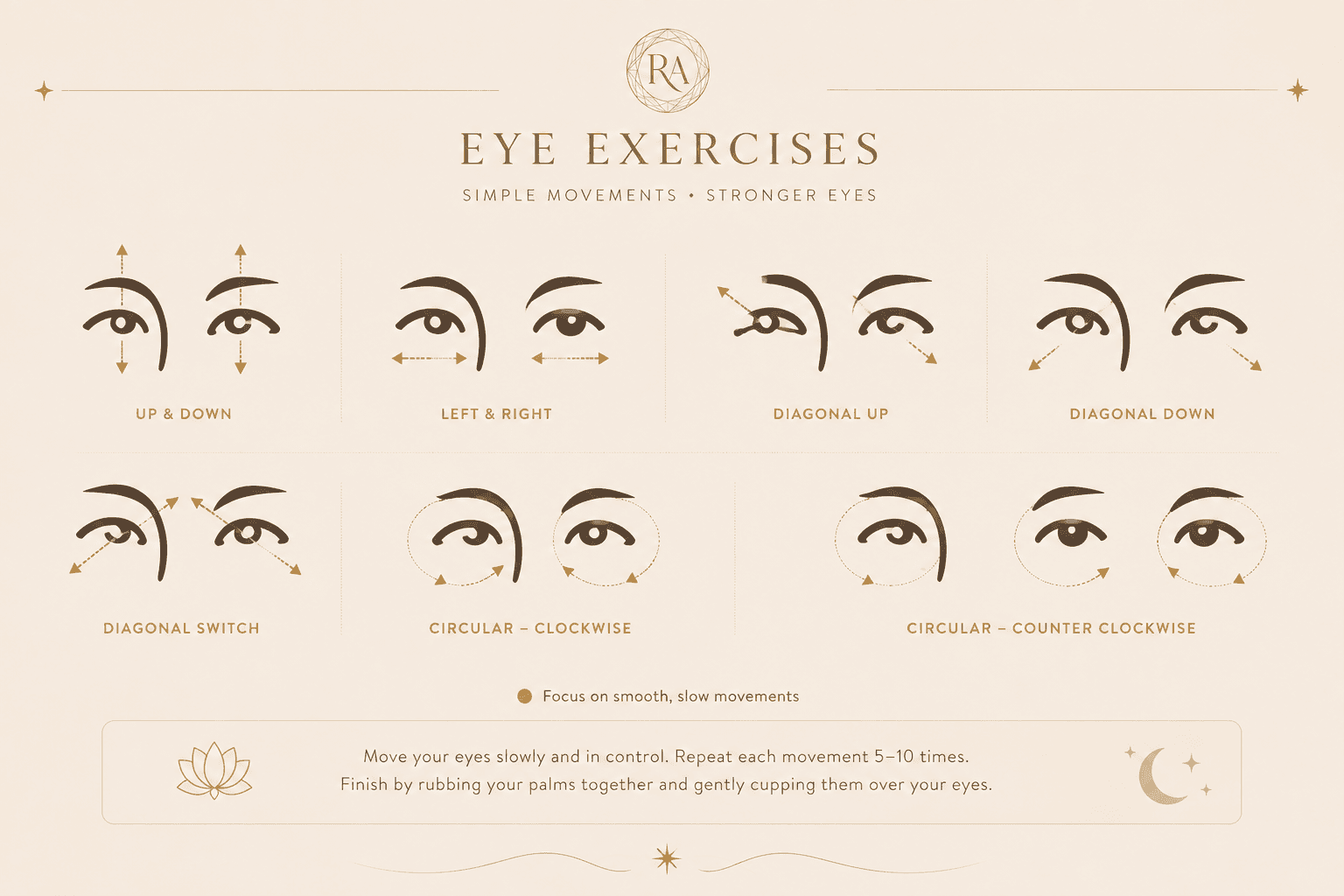
Keep the head still and let the eyes travel slowly. A small, comfortable range is enough. Blink between directions and do not strain to reach the edge of your vision.
- 1Look up, then down.
- 2Look left, then right.
- 3Look from upper right to lower left, then upper left to lower right.
- 4Trace one comfortable circle clockwise, then one counterclockwise.
Palming
Rub the palms together until they feel warm. Close the eyes and cup the hands over them without touching or pressing the eyeballs. Let the fingers rest lightly on the forehead and the heels of the hands rest on the cheekbones if that helps keep pressure away from the eyes.
Stay for 30 to 60 seconds. The value here is simple darkness, warmth, and a pause from visual effort—not a change in eye structure.
The chart and tired-eye days
A home eye chart may be used as an occasional observation tool, not as an exercise that strengthens vision. Follow the exact testing distance printed for that chart, use consistent lighting, cover one eye without pressing it, and wear the corrective lenses the chart instructions specify. A home result cannot replace a professional eye exam.
On screen-heavy days, the gentler first response may simply be to blink, look at a distant object, change position, and rest from near focus. Repeat this practice only when it feels comfortable; more pressure and more repetitions are not better.
Know when not to practice
Stop and seek prompt eye care for eye pain, significant redness or swelling, light sensitivity, new double vision, sudden blur or vision loss, a sudden increase in flashes or floaters, or a curtain-like shadow in the vision. Do not massage through these symptoms.
This practice is offered for gentle self-care and body awareness. It does not treat cataracts, glaucoma, high eye pressure, retinal disease, infection, injury, or changing vision, and it cannot replace an examination by an optometrist or ophthalmologist.