The Laboratory of God
The Organ Clock: Twelve Systems, Twenty-Four Hours
A clear guide to the twelve two-hour periods in the traditional Chinese meridian clock—and the limits of what the clock can tell us.
By Olga S., Founder & Practitioner · August 5, 2026 · 4 min read
Traditional meridian time flow
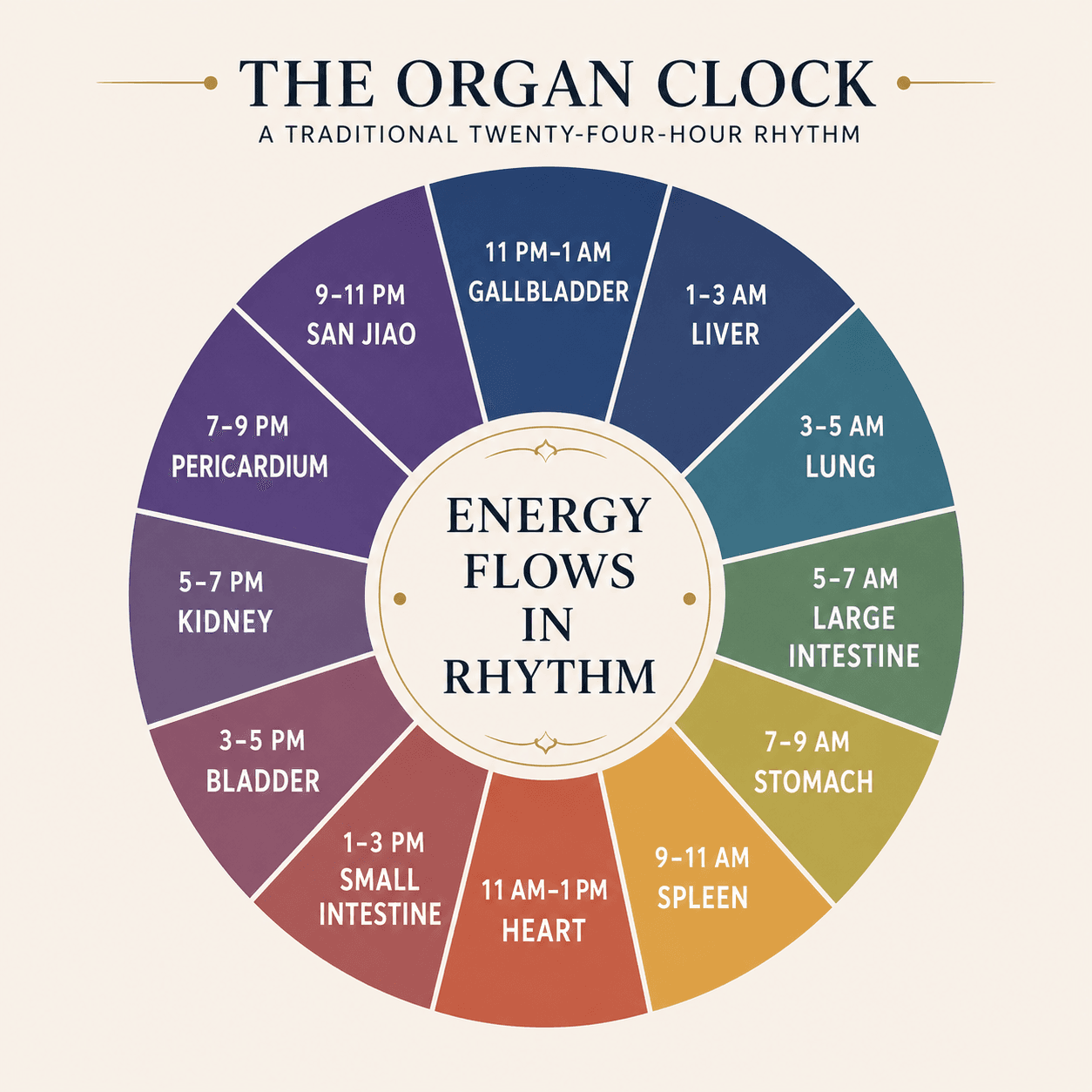
Which system holds which hours?
Each segment names the channel traditionally associated with that two-hour period. The names describe Chinese medicine systems, not exclusive hours of anatomical organ activity.
Gallbladder
Traditional association: Decision, courage, and purposeful action.
Liver
Traditional association: The smooth movement of qi, planning, and restoration.
Lung
Traditional association: Breath, dispersal, descent, and the boundary of the body.
Large Intestine
Traditional association: Receiving, releasing, and elimination.
Stomach
Traditional association: Receiving and beginning the transformation of nourishment.
Spleen
Traditional association: Transforming and transporting nourishment.
Heart
Traditional association: Circulation and the traditional concept of shen, or mind-spirit.
Small Intestine
Traditional association: Separating what is useful from what is not.
Bladder
Traditional association: Fluid pathways, storage, and elimination.
Kidney
Traditional association: Essence, growth, reproduction, and water metabolism.
Pericardium
Traditional association: Protecting the heart and supporting circulation.
San Jiao · Triple Burner
Traditional association: Coordinating qi and fluids across the body’s three regions.
A day understood as a moving cycle
In the traditional Chinese meridian clock, the day is divided into twelve two-hour periods. Each period is associated with one primary channel and its related functional system. The sequence begins with the gallbladder at 11 at night, moves through the liver and lung before dawn, and continues around the clock until the san jiao period closes the evening.
The word organ can be misleading in English. In traditional Chinese medicine, Liver, Heart, Kidney, and the other capitalized names describe broader networks of function and relationship. They are not identical to the anatomical organs described by contemporary medicine.
How to read the hours
The clock describes when qi is traditionally understood to be most abundant in a particular channel. It is a historical framework for timing, observation, and treatment—not a claim that an anatomical organ switches on for two hours and switches off afterward.
The short associations in the clock summarize traditional themes rather than medical findings. For example, the 1-to-3 AM liver period does not mean that waking at 2 AM proves liver disease, emotional blockage, or a need to detox. Sleep changes have many possible causes and deserve ordinary medical evaluation when they are persistent or concerning.
Rhythm without superstition
Modern physiology also recognizes circadian rhythms, but that does not validate every correspondence in the traditional organ clock. The two systems ask different questions and use different maps.
RA SPHERA holds the clock as a contemplative tool: an invitation to notice patterns in breath, energy, appetite, rest, movement, and daily routine. Observation can begin a useful conversation. It cannot establish a diagnosis by itself.
The organ clock is shared as traditional and educational material. Do not use a time of day, symptom, or waking pattern to diagnose an organ condition or delay appropriate medical care.